

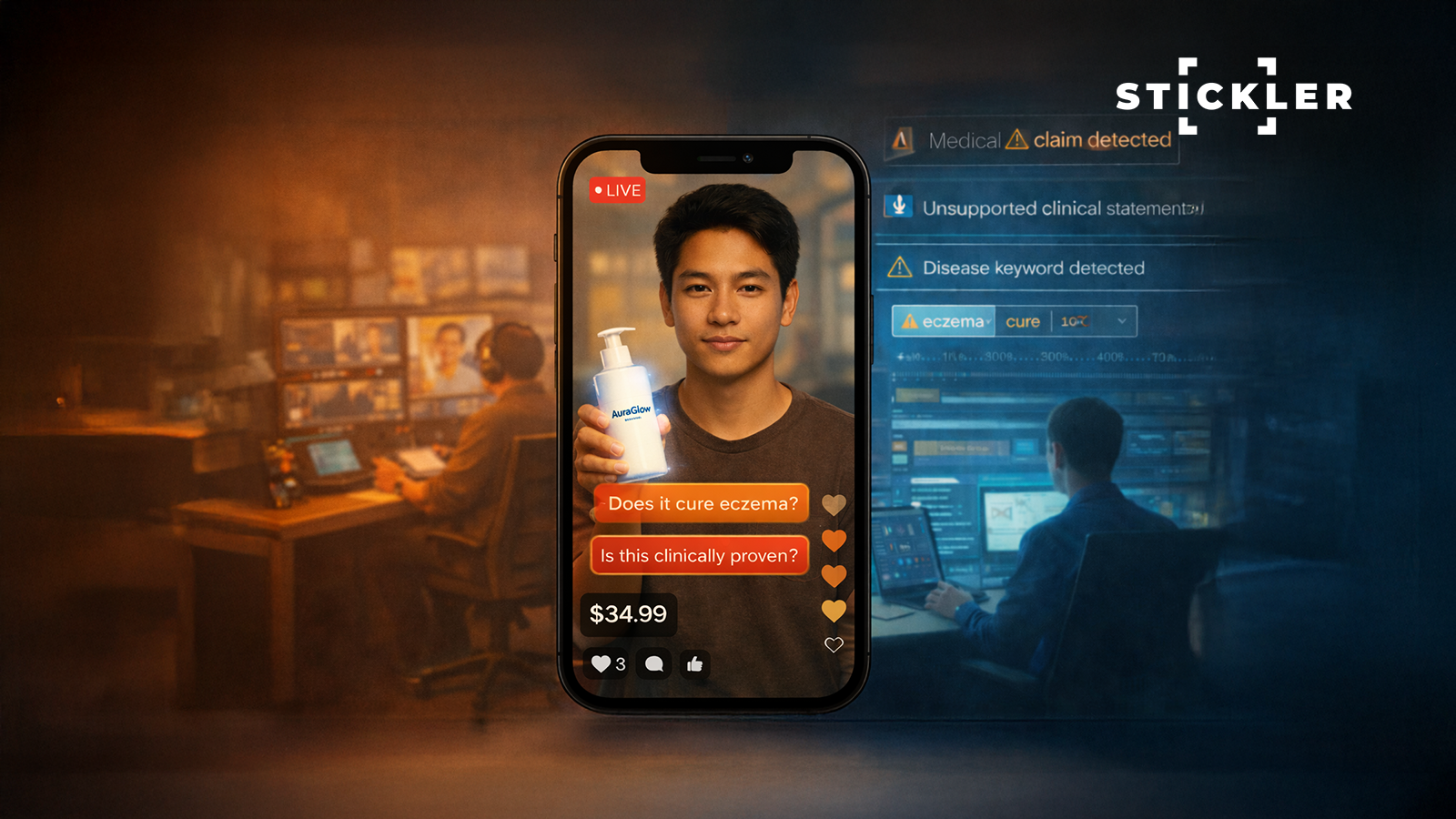
Influencers, Affiliates and Livestream Selling: The Brand Liability Problem. Avoiding platform and regulatory scrutiny in an ever evolving landscape.
Different countries have different regulations when it comes to selling to consumers but a simple truth is that Live Commerce and most forms of social selling are advertisements. Understanding what you can and can’t do as a brand, an agency or a host/affiliate is incredibly important and high stakes.
Live and social commerce have grown up quickly and the rules and regulations are catching up fast. Creators are getting violations not realising they have done something wrong. Brands are being pulled because their hosts said the wrong thing in the wrong way and the platforms halt the stream.
What began as experimental livestream shopping on platforms like TikTok Shop, Shopee, Amazon Live and YouTube Shopping has become something far bigger: a permanent retail channel operating thousands of hours of live programming every month.
For brands, it’s incredibly powerful.
For compliance teams, it’s quietly becoming a problem.
Because while the technology powering live commerce has evolved rapidly, the systems governing what is actually being said on those streams have not kept pace.
And that gap is where risk is beginning to emerge.
The uncomfortable truth: live commerce is advertising
A common misconception in the market is that livestream selling is somehow different from traditional advertising.
It isn’t.
If someone is promoting your product — whether they are:
- a brand host on your channel
- an influencer posting on their channels or using their videos
- an agency studio
- an affiliate seller
– regulators across the globe view that communication as advertising on behalf of the brand. And that means the same rules apply.
In the United States that includes the FTC’s endorsement guidelines and FDA product claim rules. In the UK it falls under the ASA. Across Europe, ASEAN and many other markets, similar consumer protection and product-claim frameworks exist.
Live content does not sit outside those frameworks simply because it is conversational or unscripted.
As the compliance framework in our recent whitepaper explains, the legal principle is simple:
If a spokesperson promoting your product makes a misleading or unsubstantiated claim, the liability usually sits with the brand.
Why live commerce creates new compliance risks
Traditional advertising goes through layers of review.
Packaging is approved. Marketing copy is checked. Campaigns are signed off.
Live commerce breaks that workflow.
A typical livestream includes:
- spontaneous product demonstrations
- viewer questions in real time
- hosts responding conversationally
- promotional urgency around pricing or stock
- creators improvising stories and personal experiences
What results is commercial speech happening at speed, often for hours at a time.
In large live commerce operations this may mean:
- dozens of hosts
- multiple studios
- several agencies or partners
- hundreds of affiliates
- thousands of hours of live content every month
At that scale, even small misstatements can multiply.
Most livestream hosts are told to do one thing:
“Be authentic.”
That instruction works brilliantly for engagement. It can be dangerous for compliance.
Under pressure to answer questions and drive sales, hosts frequently move beyond approved messaging and into anecdotal claims or medical territory.
Some of the most common examples we see include statements like:
- “This cleared up my eczema.”
- “It fixes psoriasis patches.”
- “This product is clinically proven.”
- “This is the best product on the market.”
In many jurisdictions, statements like these are not casual comments – they are regulated claims.
And when they appear on a branded livestream or affiliate channel selling the product, regulators typically treat them as advertising.
Platforms are not your legal shield
Another misunderstanding we often hear from brands is:
“The platform would take it down if it wasn’t allowed.”
It is not down to platforms like TikTok Shop and Shopee to enforce policies around health claims, prohibited products and misleading practices.
But their rules exist primarily to protect the platform, not to transfer legal responsibility away from brands.
Passing platform moderation does not mean a statement complies with:
- FTC advertising rules
- FDA product classification standards
- EU cosmetic claims regulations
- ASEAN consumer protection law
- ASA advertising codes
If anything, regulators increasingly expect brands to actively monitor and manage influencer and affiliate content.
Compliance is becoming an operational problem
The real challenge is not understanding the rules.
Most brand legal teams already know them.
The challenge is operational visibility.
When brands begin running live commerce at scale, they quickly face questions like:
- Who is monitoring what hosts actually say on streams?
- How are affiliate livestreams being reviewed?
- Are transcripts or recordings being captured?
- Can the brand prove training and guidance were provided?
- Is there a process to remove or correct problematic content?
Without answers to those questions, compliance becomes reactive.
In most cases the burden is on the brand to prove that they have educated the people fronting their products on social media. They may shield themselves with liability clauses with their agencies but in many cases these do not stand up.
By the time someone reviews a problematic clip, it may already have been viewed, shared, and recorded by the platform or shared by other users.
The CALE framework
To help brands address this issue, we recently developed a compliance framework specifically for live commerce called:
CALE — Claim Accuracy and Legal Exposure
The idea behind CALE is simple.
Instead of focusing only on written marketing copy, brands should treat everything said in livestreams and affiliate content as potential advertising claims.
The framework encourages brands to build three capabilities:
1. Clear claim boundaries
Hosts and creators need simple rules they can understand.
For example:
- No disease claims for cosmetic products
- No “clinically proven” statements without substantiation
- No misleading scarcity or pricing statements
- No anecdotal medical claims
These rules need to be communicated in plain language. Not buried in legal documents.
2. Training, guardrails & tools
Livestream hosts need practical guidance on how to handle common questions. For example:
Viewer: “Can I use this if I have eczema?”
Host response: “This product is designed as a cosmetic moisturiser. For medical skin conditions it’s best to speak to a healthcare professional.”
Simple guardrails like this allow hosts to remain conversational while avoiding high-risk claims.
Brands, agencies and tools should be using tools to help them with this. Tools like Stickler that provide Host and Moderation tools and allow hosts to follow specific wording around products and compliant language help prevent problems from occuring and tracking with Stickler or LiveScope allow brands to understand where lines have been crossed.
3. Monitoring and documentation
At scale, brands need visibility into what is actually happening on streams. That typically includes:
- capturing livestream recordings
- generating transcripts
- scanning for high-risk keywords
- reviewing affiliate content
- maintaining audit trails of training and corrections
This is not about policing creativity.
It is about ensuring that real-time commerce can withstand regulatory scrutiny later.
Compliance will become a competitive advantage
Live commerce today resembles the early years of many digital channels.
Fast growth…
Experimentation…
Loose governance…
But history suggests that phase does not last forever.
Search advertising, social media marketing and influencer campaigns all eventually moved from experimentation to structured governance.
Live commerce will follow the same path and it’s likely to be a lot faster given health, efficacy, medical and other high stakes claims made by hosts.
Brands that build operational compliance early will be able to:
- scale livestream hours safely
- maintain platform trust
- avoid costly regulatory issues
- protect brand reputation
Brands that ignore the issue may eventually discover that thousands of hours of livestream selling have quietly created thousands of potential advertising claims.
A final thought
Live commerce works because it is human.
Consumers see real people demonstrating products, answering questions and reacting in real time.
But that human conversation is also commercial speech.
And commercial speech carries responsibility.
The brands that succeed in live commerce will not be the loudest.
They will be the ones who build enough structure around that conversation to ensure that what is said in a livestream still holds up when replayed later.
If you’re interested in the full compliance framework, you can read the whitepaper here.
Or if you are scaling livestream commerce and want to understand how workflow, monitoring and compliance tools work in practice, feel free to get in touch.



 English (UK)
  Français
  Deutsch
  Italiano
  Bahasa Indonesia
  ไทย
ไทย  Bahasa Melayu
  Tiếng Việt
  Tagalog
  Español
  Español de México
  Português do Brasil
  日本語
日本語  简体中文
简体中文
Leave a Reply